
A short take on whether one line can owe another song money, under Nigerian copyright law.
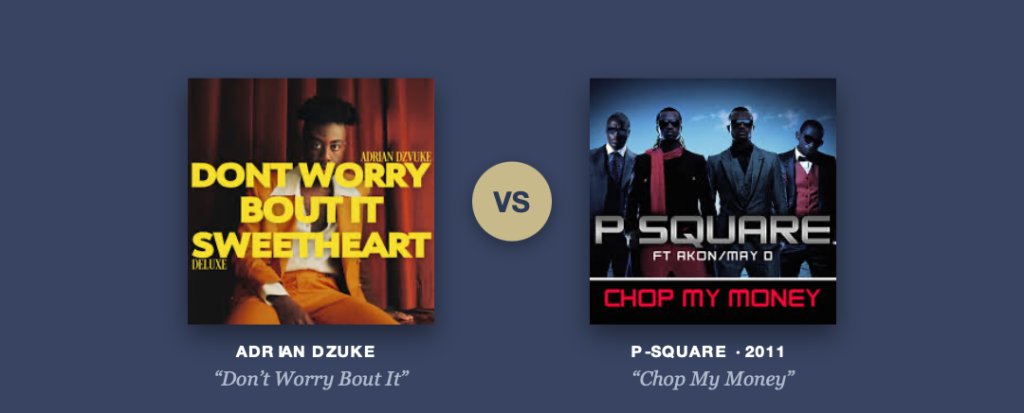
Picture the scene. Up-and-comer Adrian Dzuke drops “Don’t Worry Bout It, Sweetheart.” Fans love it. Then someone notices a familiar line tucked into the chorus: “chop my money, I don’t care.” That is, of course, the beating heart of P-Square’s 2011 smash “Chop My Money (I Don’t Care)” written by Peter and Paul Okoye.
So the question lighting up our group: should P-Square (or their publisher) be collecting royalties from Adrian?
It is a better question than it looks. Here is how we would weigh it:
CASE FOR ROYALTIES
A song’s lyrics are a protected “literary work. Under the Copyright Act 2022, musical works and the words written to accompany them are both protectable. You don’t have to copy the whole song to infringe copying a strong, substantial part is enough, and “substantial” is judged by *quality*, not just length. A single iconic line can be the most recognisable, valuable part of a record.
This isn’t a throwaway phrase; it’s the hook. “Chop my money, I don’t care” is the song’s signature.
If Adrian lifted the exact line because it carries P-Square’s recognition and goodwill, that points towards taking the part that matters most. The 2022 Act also lowered the originality bar: a work qualifies once “some effort” has gone into giving it an original character. P-Square clears that comfortably.
Borrowing the line’s fame is the giveaway.
Where a newcomer leans on an instantly recognisable hook to make their own track land, that looks less like coincidence and more like riding someone else’s creativity.
CASE AGAINST ROYALTIES
Short, common phrases are weak copyright material. Copyright protects original expression, not ordinary language or ideas.
“Chop my money” is everyday Nigerian Pidgin, to spend someone’s money freely, and “I don’t care” is about as generic as English gets.
Courts are reluctant to let anyone fence off common speech. Owning the song is not the same as owning the words in isolation.
A few words may not be a substantial part. The substantiality test cuts both ways. A short, commonplace line, without P-Square’s specific melody, beat, or arrangement, may simply be too thin to count as taking the heart of the work, especially if Adrian’s melody, key and delivery are entirely his own.
Independent creation and fair dealing. If Adrian arrived at the same colloquial phrase on his own, there is no copying at all. And even deliberate use can sometimes shelter under fair dealing (e.g. parody, pastiche or quotation) depending on how the line is used.
The Verdict
On balance, a bare lyrical phrase like this is unlikely, on its own, to earn P-Square a royalty; short, idiomatic snippets rarely meet the substantiality and originality thresholds the courts demand. P-Square own “Chop My Money”; they do not own the Pidgin phrase “chop my money.”
But the answer flips fast on the facts. If Adrian reproduced the melody the line is sung to, or the recognisable cadence and hook arrangement, then it is no longer “just words”, it edges into copying the part that makes the song ‘that song’, and a claim becomes real.
The safe move for any artist in Adrian’s shoes is the boring-but-bulletproof one: clear it, or change it.